Culinary Notebooks & Writing in the Kitchen
Table of contents
Tags
Related pages
Preface
I’m fond of cooking. To the point that I cook the majority of meals at home despite my health hassles. It’s the one thing I refused to give up when my health fell apart completely and totally. I would stand with my legs pressed against the cabinets, oven door, etc and I’d lock my arms to stop the shakes and I’d play the part of stubborn mule to make dinner or lunch or meal prep or similar.
This was brutal on all levels but I refused to let my health take away one of the most important creative outlets I have. Arguably, the most important. As part of keeping cooking in my life I went digital to a point. I cataloged all the recipes digitally, took notes on a phone that had a good IP rating and more. I adapted in a major way. It was the only option and I loathed having to lean into digital so deeply to keep cooking in my life. I did use this as a reason to lean into my culinary site a bit. I even set up a special area in my Zotero research setup for all things culinary (articles, recipes, etc) which allows me to track things and share my work with others.
While the culinary site and Zotero are nice and still in use, I really do avoid anything digital in the kitchen with the exception of thermometers, timers, scales and the like. I do have an Instant Pot, Ninja Blender and a KitchenAid stand mixer but they do one thing well and are not in any way “smart”. I push buttons and they do things. I even have a fridge that just has dials to set the temperature and a power wire. If I could, I’d probably drop some of these on pure principle but I’m willing to allow electricity to make life a hell of a lot easier and faster for highly physical tasks, even if my health hassles weren’t this bad.
In a major win, my health was stabilized a bit and I no longer convulse non-stop. This let me fight less to cook and I’m again able to write with a pen and paper. Mostly. I still have terrible days that block me from analog writing but it’s no longer constant. This allowed me to dump my deep digital life hacks and shift back to analog.
To say I was excited to get back to analog in the kitchen would be extreme understatement.
Oops
Interestingly I never kept a recipe book or similar prior to my health falling apart completely. I worked from my partner’s family recipe book they made and online recipes I had printed or HelloFresh recipe cards (it was a brief flirtation) and similar. When my health was finally managed to a point where I could write again, I went on an analog bender and got my shit together.
I spent non-trivial amounts of time looking into what I needed to dump digital as completely as is reasonable when cooking. After a couple false starts, I pulled it off. I was able to put together a culinary setup for recipes, notes, and more that I won’t give up. It is very efficient, easy to manage and is analog in a way that’s not going to get destroyed in a kitchen environment.
Given a kitchen is hostile to paper, ink and more; it took more research to put together a kit than most realize. I wanted kit that could survive liquids, heat, and food while lasting longer than my grandma’s recipe box of awesome. Preferably without rusted ink, faded to nothing note cards and the like. When looking at long time horizons and the hostility a kitchen brings to bear, this feels impossible. It’s not. You just need to look towards the hardcore analog writing nerds and their tools. The good news is I’m very much one of these hardcore nerds.
Writing Instrument
One of the first things I did was track down three 2.0mm lead holders. One for HB lead, one for a ‘good’ color and one for a ‘bad’ color. I was lucky in that I found both green and red lead as well as holders in both green and red. I also got hands on a lead pointer. The last thing I wanted was a container for extra lead. Sadly this was a huge pain in the ass. I ended up buying a lead refill pack that had a metal case, emptied it, cut my 2.0mm lead in half then refilled the container with my own leads. Not ideal, but it works really well and is compact like I want.
Binders & Paper
From here I switched to binders, organizer setups and papers. I don’t like index cards for my recipes and opted to look at A5 and B5 paper instead. I find these are great, standard sizes when you need to balance information density with physical size.
There are a ton of options here. Even if you’re looking for more durable papers or archive papers. I ended up choosing Maruman B5 due to availability and durability. They also sell non-thick polycarb binders in B5 so I don’t have to keep a tome on the counter when I need a recipe or reference info.
The next problem I had to solve was note taking and similar. I tend to go for smaller pages for the ‘misc writing’ I do in the kitchen and ended up going with Maruman again. This time a horizontal orientation, modified B7 setup. It’s basically a mini version of my main recipe books and the holes in the mini notebook align with the recipe books so I can easily transfer pages into my ‘work in progress’ notebook.
Slide Rules & Addiators
As I was working through all this, I discovered slide rules would have saved me a massive amount of pain in the past when adapting and converting recipes. Particularly ratios. I ended up obtaining a Pickett Microline 160 for use in the kitchen just before I went looking for a mini notebook. Because the slide rule is horizontal I went with a horizontal mini notebook to help make using them together much easier. I even bought an Arithma Addiator to round out the ‘pure analog’ kit. I don’t generally need an addiator or similar help with arithmetic but I figured I should put together a whole kit from the start. I also wanted to ensure I had no reason to reach for an electronic calculator or similar going forward.
Pencil Case
My last purchase was a pencil case. I had amassed enough note taking and writing kit for use in the kitchen to cause me to have trouble keeping things organized. After more research than I’d have preferred and more measuring than I like; I found a case from LIHIT LAB that lets me keep everything together, including the mini notebook. It turns into a kind of ’tray’ when opened and has a band on the back to allow it to be attached to the cover of a binder; or in my case: a modified B7 mini notebook.
The Win
Once I had the case sorted I realized I had fully displaced the need for digital in the kitchen and, to this day, I don’t bother with digital.
Below you’ll find an exact list of what I’m using, pictures and an appendix with more detail about my decision making. I figured folk don’t care as much about the minutiae but I wanted to be sure it was included for those who would like to know more about how I made my selections.
The Kit
Writing Utensils
- KOKUYO Pen Case (F-VBF170)
- Staedtler 925 Black 2.0mm lead holder
- KOH-I-NOOR Red 2.0mm lead holder
- KOH-I-NOOR Green 2.0mm lead holder
- Mars Carbon 2.0mm HB lead
- Mars Lumochrom 2.0mm Crimson (Red) lead
- Mars Lumochrom 2.0mm Green lead
- Mitsubishi Uni metal lead case (0.5mm HB / ULSM05HB)
- Kita-Boshi 2.0mm lead pointer (pencil lead sharpener)
Mini Notebook
- Maruman Into-One+ B7 (modified) Mini Binder
- Maruman B7 (modified) 5mm graph paper
Main Notebooks
- Maruman 5 Chart Binder B5
- Maruman Clarte B5
- Maruman B5 5mm Easy to Write graph paper
Analog Calculators
- Arithma Addiator
- Embossing Stylus
- Pickett Microline 160 Slide Rule
Pictures
Supplies
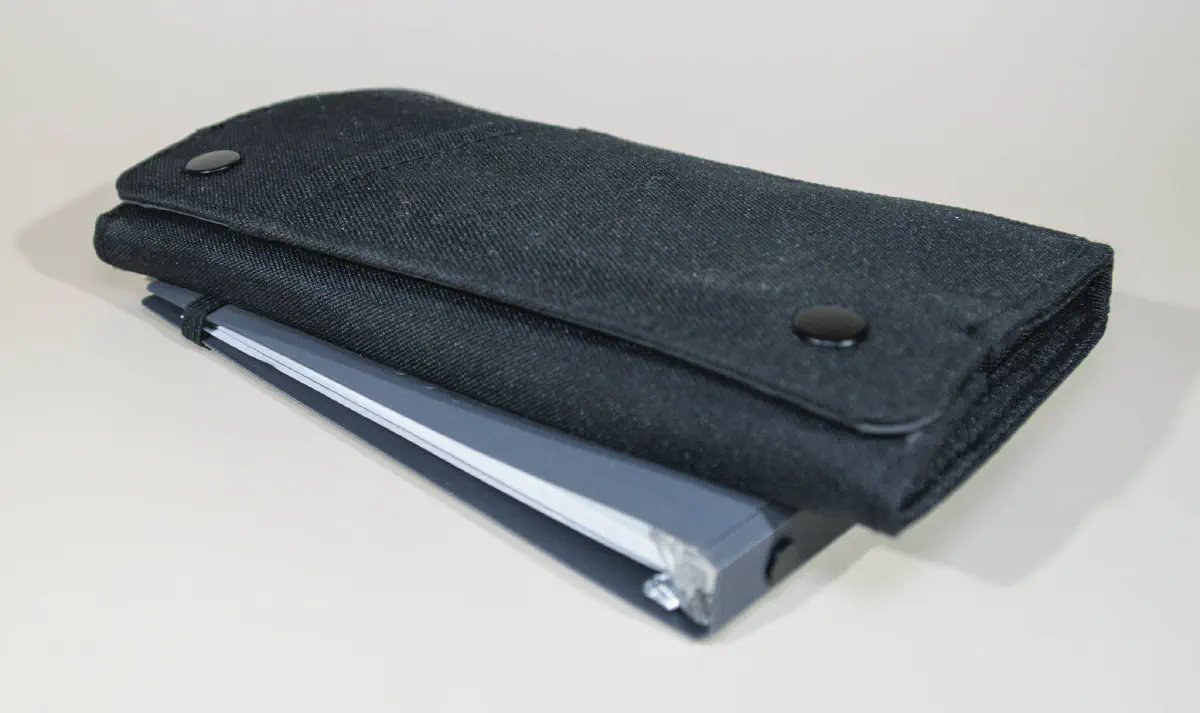
The supplies put away for storage
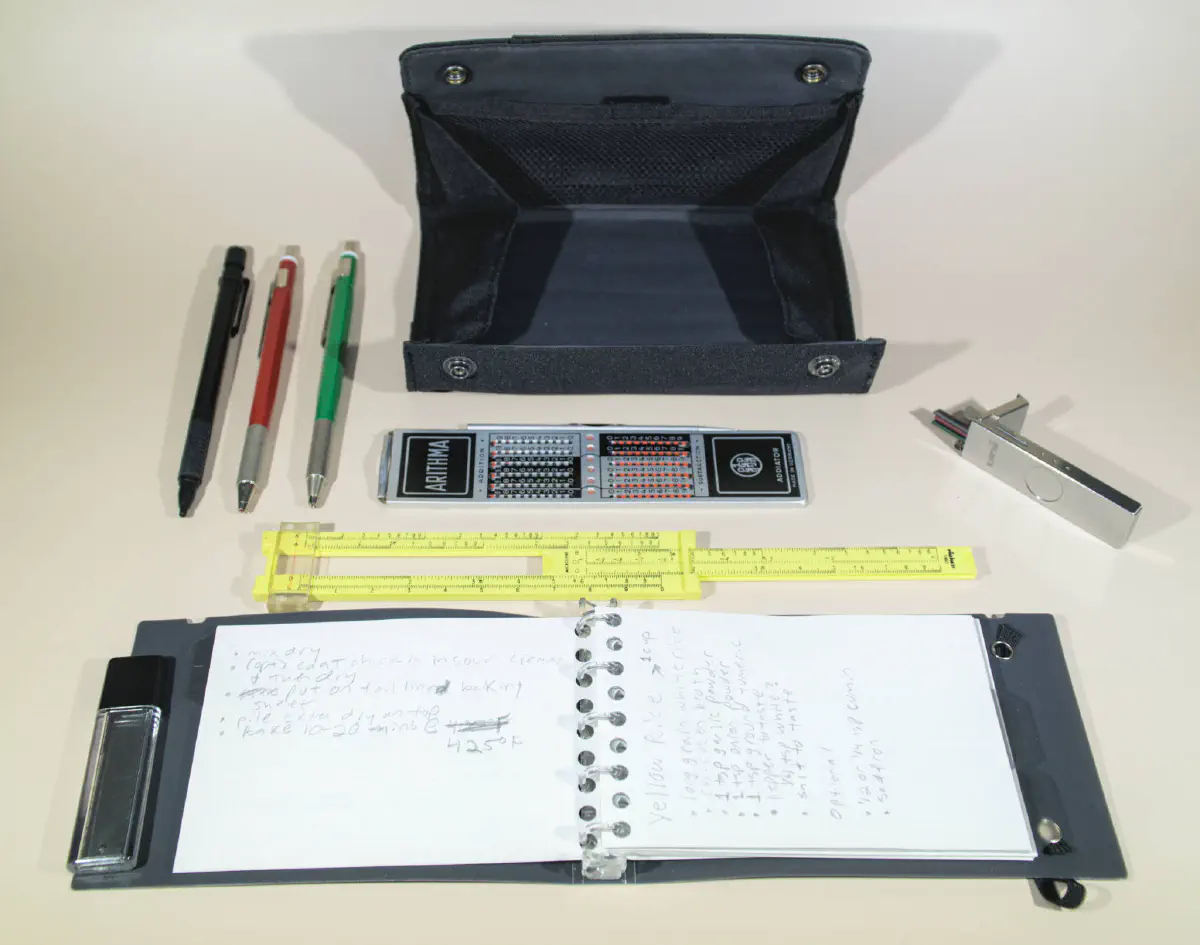
The supplies spread out for use
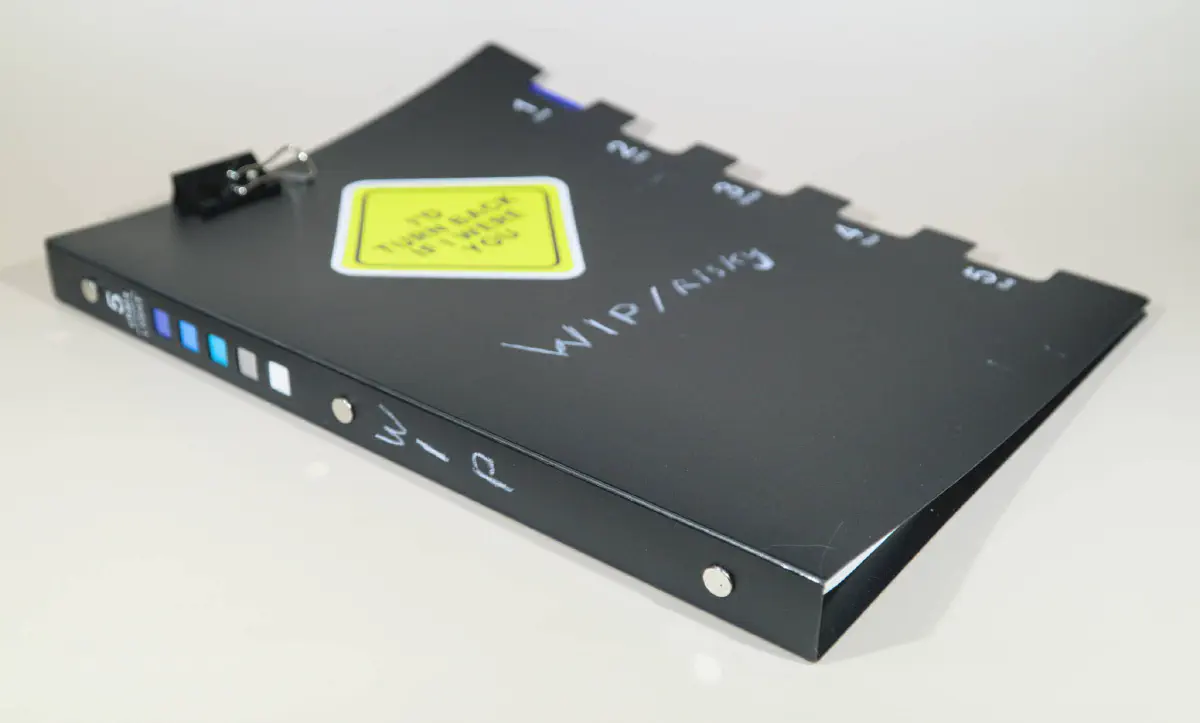
The WIP recipe book
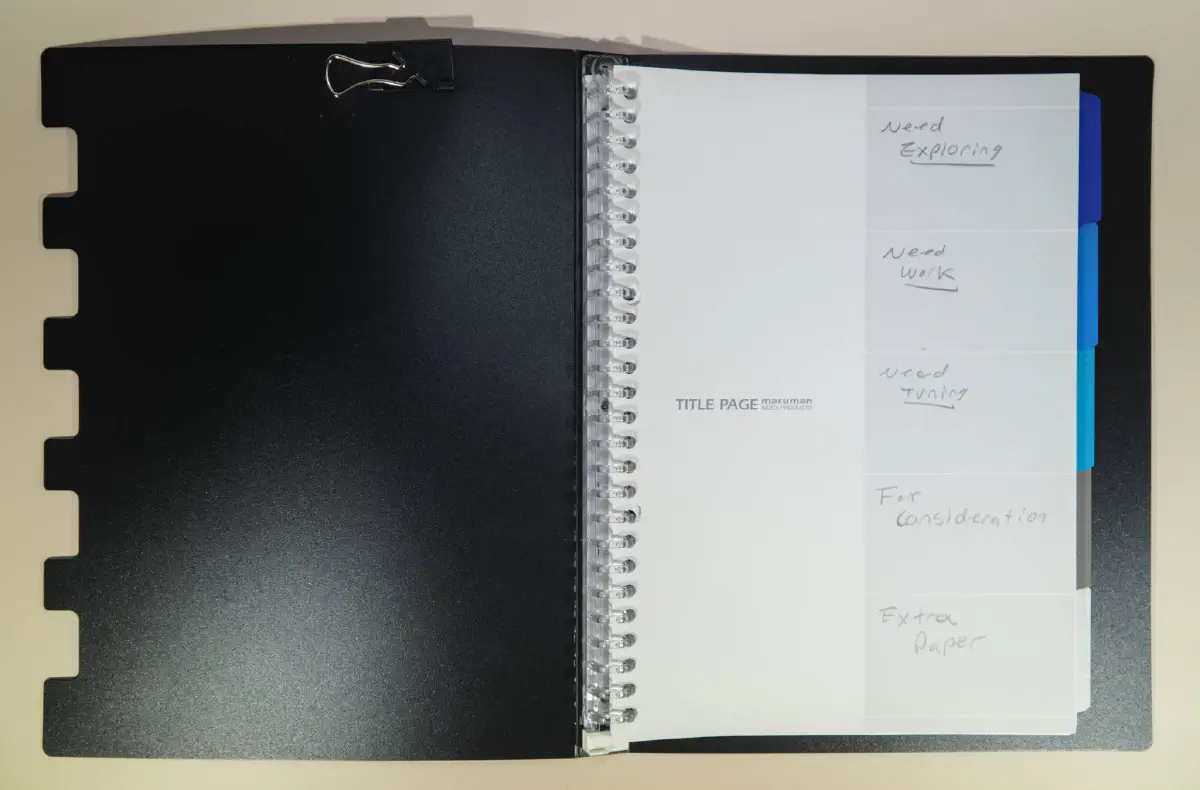
The index of the WIP recipe book
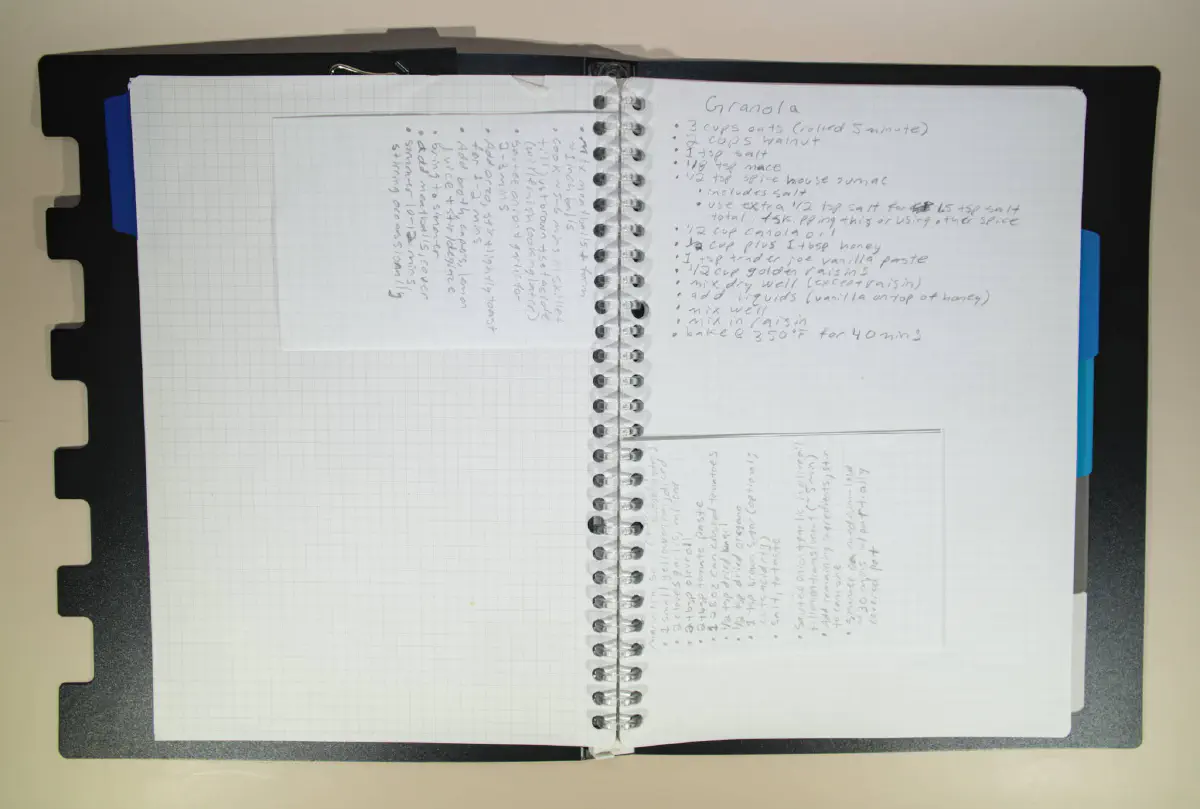
The main recipe development section of the WIP recipe notebook
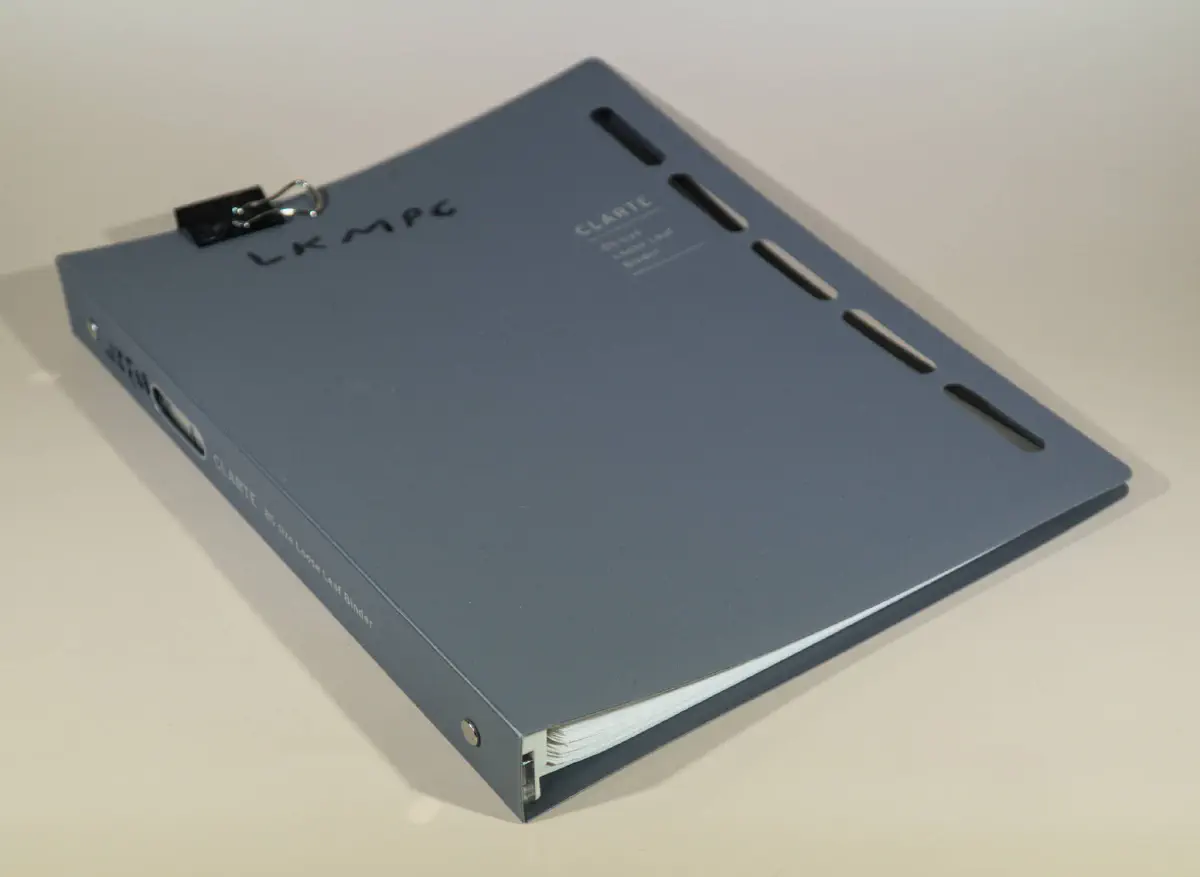
The main recipe book
Appendix
Paper Selection
The biggest paper constraint for me was ’needs binder’ followed by ‘archive’ and ‘durable’. I also prefer A5 pages with 5mm dot grids.
Everything else was effectively secondary.
This is not the easiest blend of concerns to find in a single product. Thankfully the Japanese brands tend to have most of these properties. Particularly LIHIT LAB, KOKUYO, Maruman and probably others. Normally I prefer LIHIT LAB but the Maruman binders fit my needs best so I went with their offerings. I recommend all 3 brands and each is perfectly valid. Maruman just happened to check the most boxes for me.
Binder Selection
I went with polycarb binders because polycarb is damn near indestructible. You can dissolve it in acetone and other chemicals but I’ve found I’m not playing with highly toxic anything in the kitchen (usually).
Polycarb plastic is also regarded as likely to outlast the human species.
It’s not ideal (I’m not a fan of plastics) but it does work and meets my needs quite well.
Writing Utensils
Normally I’d just buy a fountain pen with Japanese EF nib and fill it with Platinum Carbon Black ink and be done. It’s my go-to setup and the ink is, in effect, permanent and well beyond ‘archive grade’. In the kitchen though, Platinum Carbon Black isn’t the best choice. It’s only durable once dry and it takes some time to dry. Longer than you’d want in an environment dealing with liquid heavily. The fact I wanted to be able to get my writing wet while ‘fresh’ (by accident) pushed me away from pens entirely and right into my Completely Waterproof writing option: the pencil.
Pencil is truly waterproof and you can write underwater if using wax coated or polymer papers. Perfect for kitchen needs.
Strangely I prefer a 2.0mm lead (aka: ‘wood pencil lead’ with a mechanical pencil body). For whatever reason the smaller lead sizes don’t work for me at all. I also prefer more texture with pencil and use Mars Carbon lead. Mars Carbon is almost always called out as a good lead but not all that smooth like you’d have with Uni leads.
I went with the colored leads I did because I like Staedtler products overall and didn’t want to go hunting in the land of colored pencil. The color leads are more smooth than I prefer but they do the job I need and are just as durable as the Mars Carbon leads from what I can tell.
Slide Rule, Addiator, Mini Notebook
For the slide rule, addiator and mini notebook I basically went for ‘what can I fit inside a sheet of A5 set on its side’. Set on its side because slide rules are very horizontal in nature and I wasn’t interested in figuring out how to use the lesser known circular forms.
Note: A5’s long edge is the approximate width of 2 sheets of A7 set side by side along the short edge. This allowed me to track down an A7 notebook in a horizontal orientation. Just common enough to be obtainable but not rare enough to be a major problem.
For the slide rule and addiator, I effectively measured everything and went hunting for items that fit the requirement as closely as possible. It was a PITA and there are a shocking number of options to choose from when it comes to slide rules and addiators.
I strongly recommend paying attention to dimensions if you walk this path. I underestimated the fact a slide rule is, in effect, 2x its closed length when used and an addiator is usually incredibly tall (I use mine sideways). These facts aren’t always obvious in pictures and I discovered these quirks the hard way as I was not paying close attention to dimensions up front.